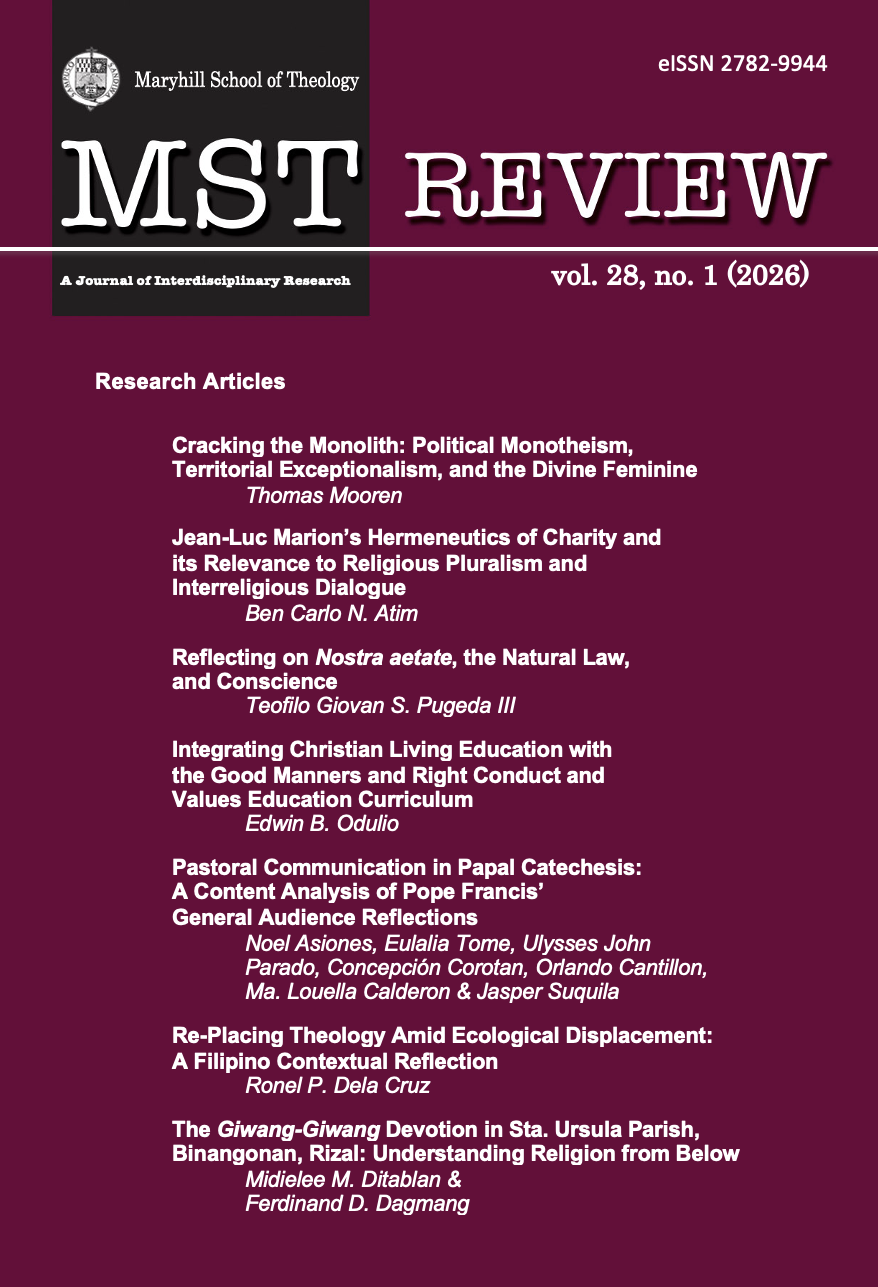
The Giwang-Giwang Devotion in Sta. Ursula Parish, Binangonan, Rizal
Understanding Religion from Below
DOI:
https://doi.org/10.67641/mstr.v28i1.2026Palabras clave:
Giwang-Giwang, Somatic Catholicism, Solidarity, Damay, Malasakit, Embodiment, Folk ReligionResumen
This article investigates the celebration of Giwang-Giwang processional devotion during the Good Friday Prusisyon ng Paglilibing in Binangonan, Rizal, Philippnes. Through ethnographic field work, it documents the twelve-hour procession, the ritual involving thousands of predominantly male devotees intensely swaying the carroza (carriage) of the Santo Entierro (dead Jesus). It utilizes participant-observation to position the ethnographer within the moving mass, treating the body as an epistemological tool to capture the sensory-saturated ritual. The study integrates the conceptual frameworks of Filipino (Enriquez, Mercado, Ileto) and Western scholars (Mauss, Durkheim, Turner, Bourdieu) to provide both grounded and theoretically elevated insights. Findings reveal that through shared physical suffering, the mamamasan (bearers) transcend ordinary consciousness to experience divine grace (biyaya) and channel male energy into communal cooperation and solidarity. This characterizes their expression of a somatized spirituality. Ultimately, this ritual serves as an anchor for Binangonan’s local identity and collective memory.
Descargas
Publicado
Cómo citar
Número
Sección
Licencia
Derechos de autor 2026 Ferdinand Dagmang, Midielee Ditablan

Esta obra está bajo una licencia internacional Creative Commons Atribución-NoComercial-SinDerivadas 4.0.